

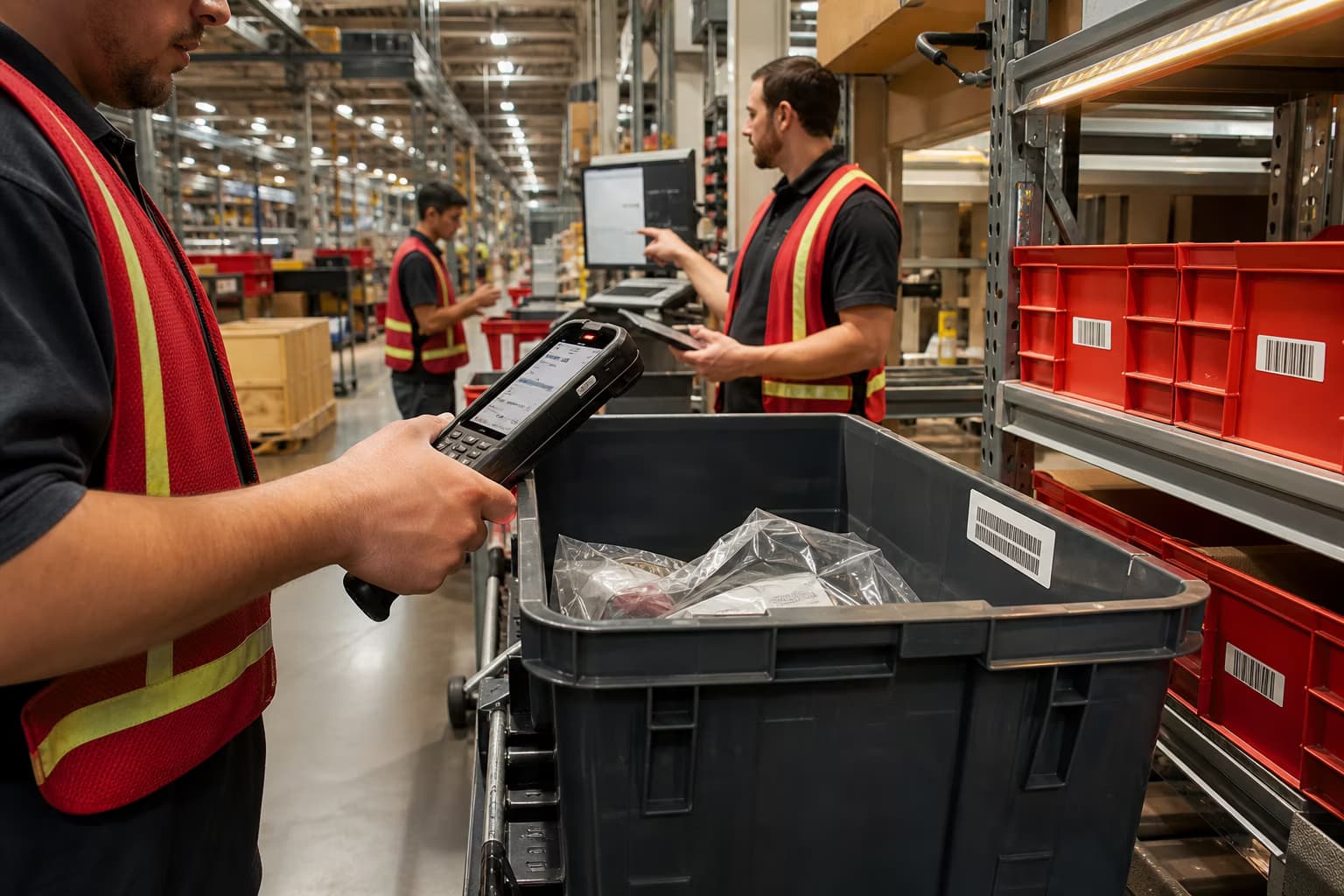
Real-time inventory is more than displaying a current number on screen. Every balance must be explainable through receipt, put-away, picking, transfer, count and adjustment movements.
Short answer
What is a WMS? Live inventory and transfer control in warehouse management
Live inventory control in a WMS (warehouse management system) is more than displaying a current balance; every quantity must be explainable through receiving, put-away, picking, transfer, count and adjustment movements. Location and barcode checks should happen at transaction time.
Key takeaways
- Derive inventory balances from movement history.
- Place barcode verification at the right workflow step.
- Instead of silently correcting exceptions, record them with a reason and approval.
Never change a balance without a movement record
Updating an inventory balance directly erases its history. Instead, create a movement record containing source, destination, quantity, product, user and timestamp.
Maintain location accuracy at the point of action
If a product is in the correct warehouse but on the wrong shelf, the system balance may appear technically correct while floor operations break down. Verify source and destination location barcodes during the movement.
Track picking and packing as separate steps
Re-verifying the picked product at the packing station helps catch missing, extra or incorrect items before dispatch.
- Preserve task and order identifiers.
- Record partial-pick status explicitly.
- Keep exception reasons limited and meaningful.
Treat transfers as two-ended transactions
A transfer is not simply a deduction from source inventory. Dispatch, in-transit and receipt confirmation should be tracked as separate states.
Keep count discrepancies open to investigation
Count results should not erase the movement record; they should create an adjustment movement and approval record for the discrepancy. This enables root-cause analysis.